
Fluoride in Drinking Water: Is It Safe and Should You Remove It?
Updated: 22 minutes ago
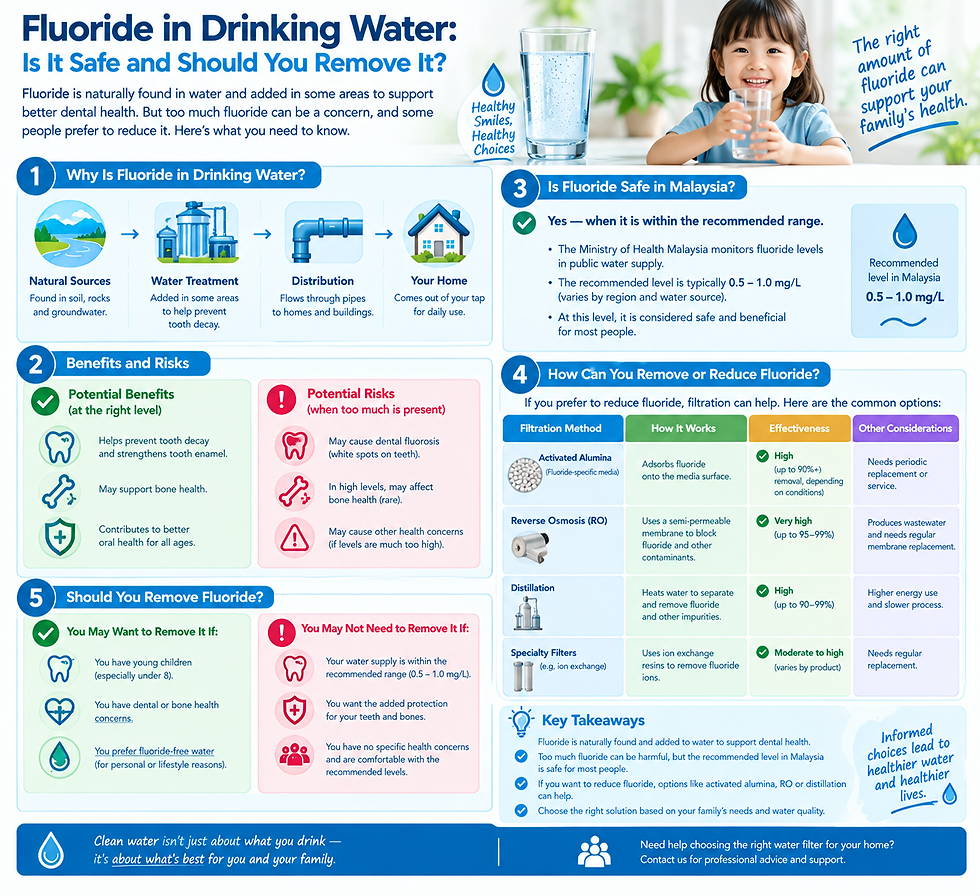
Fluoride in drinking water has been one of the most widely discussed topics in water treatment and public health for decades. While some countries add fluoride to their public water supplies to help improve dental health, others choose not to fluoridate their water at all.
This often leaves homeowners asking an important question:
Should I continue drinking fluoridated water, or should I consider removing fluoride from my home's water supply?
The answer is not simply "yes" or "no." It depends on your personal preferences, your family's needs, your local water quality, and the scientific information available. This article aims to provide an objective overview so you can make an informed decision.

What Is Fluoride?
Fluoride is a naturally occurring mineral found in rocks, soil, groundwater, rivers, and lakes. Small amounts of fluoride are naturally present in many water sources around the world.
In some countries and regions, fluoride is also added to public drinking water as part of community water fluoridation programs intended to help reduce tooth decay.
The amount of fluoride present in drinking water can vary depending on:
Natural geological conditions
Local water treatment practices
Government regulations
Regional water sources
Why Is Fluoride Added to Water?
Fluoride has been added to public water supplies in many communities because it is claimed that controlled levels may help reduce tooth decay and strengthen tooth enamel.
For many decades, water fluoridation has been regarded by public health authorities as one method of improving dental health at a population level.
However, opinions differ around the world. Some countries continue water fluoridation programs, while others rely on alternative methods such as fluoride toothpaste and professional dental treatments.
Understanding Sodium Fluoride
Some consumers are surprised to learn that sodium fluoride, in its concentrated form, has historically been used in certain industrial applications, as well as in some pesticide and rodenticide products. Like many chemicals, however, its effects depend on the concentration, dosage, and level of exposure.
When sodium fluoride is added to water, it dissolves into sodium ions and fluoride ions. The ongoing discussion surrounding fluoride is therefore not about the name of the chemical itself, but about the potential effects of long-term cumulative fluoride exposure and whether individuals should reduce unnecessary intake where possible.
As with many health-related topics, scientific research continues to evolve. We encourage readers to explore information from reputable sources, understand the evidence, and make informed decisions based on their personal circumstances and preferences.
Is Fluoride Safe?
Many health authorities consider fluoride safe when present within recommended levels. However, like many naturally occurring minerals and chemicals, excessive intake over a prolonged period may increase the risk of unwanted health effects.
Scientific studies have investigated potential associations between high fluoride exposure and conditions such as:
Dental fluorosis
Skeletal fluorosis in areas with naturally high fluoride levels
Bone-related concerns
Possible effects on cognitive development in children, which continue to be the subject of ongoing research
It is important to recognize that many of these concerns relate to higher cumulative exposure over time, rather than normal exposure alone.
Why Are More Families Choosing to Reduce Fluoride Exposure?
In recent years, more homeowners have started paying closer attention to what is present in their drinking water. While fluoride has long been used in public water supplies for dental health purposes, many families are choosing to reduce their fluoride intake as a personal health and lifestyle decision.
Some of the reasons include:
Ongoing scientific research continues to investigate the effects of higher cumulative fluoride exposure, particularly in children and developing bodies.
Personal preference. Some families choose to minimize unnecessary chemical intake whenever practical.
Greater awareness of water quality. Consumers today are more informed about the different substances that may be present in their drinking water and want greater control over what they consume.
Advances in filtration technology. Modern filtration systems using technologies such as activated alumina and reverse osmosis can reduce fluoride levels, whereas many standard water filters cannot.
A personalized approach to health. Every household has different priorities, water conditions, and preferences. Many people choose to conduct their own research, review the available scientific evidence, and decide whether fluoride reduction is appropriate for their family.
Ultimately, the decision to reduce fluoride exposure is a personal one. Understanding your local water quality, reviewing credible scientific research, and choosing the right filtration technology can help you make an informed decision that best suits your family's needs.
Can Water Filters Remove Fluoride?
Yes, but not all water filters are designed to remove fluoride.
Common technologies that can reduce fluoride include:
Activated alumina media
Reverse osmosis (RO) systems
Specialized adsorption filtration media (such as Xsorb-based solutions)
Standard carbon filters (commonly used for taste and chlorine removal) do not effectively remove fluoride.
This is why it is important to choose the right filtration technology based on your water quality needs.
Choosing the Right Solution for Your Home
There is no one-size-fits-all solution when it comes to water filtration.
The right system depends on:
Your local water quality
Your household needs
Your health considerations
Your budget
Your preference for maintenance level
At Water Filter Malaysia, we offer multiple filtration technologies from different brands. This allows us to provide unbiased recommendations based on your actual needs rather than promoting a single product line.
Key Takeaways
Fluoride is a naturally occurring mineral commonly found in drinking water.
It is added in some regions to support dental health.
Excessive fluoride intake over long periods may lead to health concerns.
Not all water filters remove fluoride.
Advanced filtration media or reverse osmosis systems are required for fluoride reduction.
The right solution depends on your water quality and household needs.
Frequently Asked Questions (FAQ)
1. Is fluoride in drinking water harmful?
At controlled levels, fluoride is generally considered safe. However, excessive long-term exposure may lead to health concerns in some cases.
2. Can boiling water remove fluoride?
No, boiling water does not remove fluoride. It may actually increase concentration due to evaporation.
3. What is the best filter to remove fluoride?
Reverse osmosis systems and activated alumina-based filters are commonly used to reduce fluoride levels.
4. Do all water filters remove fluoride?
No. Most standard carbon filters do not remove fluoride effectively.
5. Should I remove fluoride from my water?
This depends on personal preference, health considerations, and water quality. A water test is recommended before making a decision.
Need Help Choosing the Right Water Filter?
Every home and business has different water quality, usage requirements, and budgets. That's why there is no one-size-fits-all water filtration solution.
At Water Filter Malaysia, we provide unbiased recommendations by offering multiple trusted brands and filtration technologies. Instead of promoting a single product, we recommend the solution that best suits your water quality, lifestyle, and budget.
Whether you're looking for a whole house filtration system, fluoride removal, anti-fluoride-in-drinking-water-is-it-safe-and-should-you-remove-itlimescale protection, drinking water solutions, or commercial and industrial water treatment, our experienced team is here to help.
Contact us today for friendly, professional advice and let us help you find the right water solution for your home or business.
"Understanding what's in your water is the first step towards making informed decisions about what your family drinks every day."
About the Author
Peter Hwa is the founder of Water Filter Malaysia and has been helping Malaysian homes and businesses choose suitable water filtration solutions since 2012. Drawing on years of hands-on industry experience, he focuses on providing honest, practical, and unbiased guidance to help people better understand water quality, filtration technologies, and long-term water solutions. Through the Water Filter Malaysia Knowledge Centre, Peter shares educational content designed to help readers make informed decisions with confidence.


Comments